alumni relationsAdvancement Business: alumni relations

Pages

Showing posts with label alumni relations. Show all posts

transforming higher ed institutions to social businesses

There was a time, back when we walked ten miles uphill in the snow to get to school, that traditional marketing combined with recruitment fairs and fundraising campaigns meant steady university revenue. No longer.  

Students, as "customers", are informed and influenced by a social community and by our adaptability to their needs, not by recruitment officers with shiny pamphlets. Donors, as "partners", rightfully demand information sharing, engagement and value, just as they would of the companies they invest in and purchase from.

How can we give them what they seek? Enhance what we already do well -  knowledge sharing and community building - with the evolution of social media, social marketing and, wait for it...social business.

Social business, as defined by SideraWorks is:

"the creation of an organization that is optimized to benefit its entire ecosystem (customers, employees, owners, partners) by embedding collaboration, information sharing, and active engagement into its operations and culture. The result is a more responsive, adaptable, effective and ultimately more successful company."
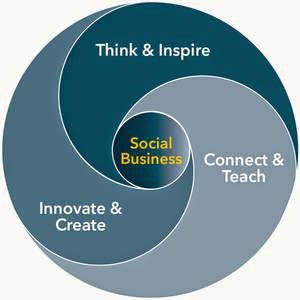
source
Isn't this what higher ed institutions are good at (or at least aim to be good at) naturally? Our researchers constantly look for inspiring cross-discipline and industry collaborations. Our core mission is effective information sharing with students and the community. Engagement of students, alumni, employers and donors is at the core of student service and advancement offices.

The only stretch is now to do all of these good things in a more strategic way, on a much bigger platform, and for a much wider audience.

But it takes work.
  • It means a heck of a lot of transparent internal communication and installing the right technology platforms to do it with. 
  • It means educating leadership on the benefits of empowering all employees to solve problems, share insights and connect with each other and directly with our customers and partners in order to adapt and evolve.
  • It means involving our customers in forming what the product they are paying for will be.
  • It means a shift in thinking by the marketing team to publish content that is consumer and partner-centred, instead of news celebrating our own achievements and credentials. 
  • It means convincing faculty members that giving their time to speak at public seminars and blog about insights into industry or society will pay off for them in the future with more funding for their work. 
  •  It means listening to what our alumni need to improve their lives and then giving it to them, instead of flooding them with emails to attend events that may not be meaningful to them.
  • And it means directing financial and human resources to take advantage of new social technology and opportunities. 
The result of this effort is surely worthwhile. Adapting our organizations to a social business model will strengthen brand reputation and relationships since value, service, authenticity and transparency will resonate quickly with our audiences. We will become a true community, not an institution.

And the revenue will follow. More importantly, that revenue will be more purposefully directed to the projects and programs that have direct impact on growth - because it will come from partners and customers making informed choices due to engagement with the people who are creating change.

Demonstrating value, connectivity, and collaborative innovation is what will transform an institution into a social business, and thereby drive advancement success.

Note: another good resource on how to build a social business is at Social Business Forum.

from donor pyramid to advancement pyramid

I'm a big fan of advancement shops over separate marketing, alumni and development shops. And here's why. It's almost impossible for marketing and alumni folks to directly connect their good work on a daily basis to the ultimate goal of revenue if they do not see strategies and tactics and results that move people from conversations and engagement to giving. 

Everyone working in higher education these days knows that universities and colleges are struggling to make ends meet. University leadership is therefore very focused on the bottom line, in order to meet the mission of high-quality research output and knowledge transfer to students and community. 

The best way to boost the university bottom line is by bringing in new revenue. A complete advancement shop whose many resources are all tasked with adding revenue creates a clear and inspiring goal for staff to work toward. 

Does that fly well with marketing shops who are working on building reputation or alumni shops who are building relationships? In my experience, yes. It inspires them to do even better work because they clearly see how reputation and relationship building are critical for new revenue generation and enhancing the university's impact on society. 

Here's how my shop has done it. We've gone from using the traditional donor pyramid to adding a conversation pyramid and an engagement pyramid as well. This "advancement pyramid" reminds us that it takes the whole team working toward the same goal to make a significant impact.


What do think? Do you agree with a shared advancement mission of revenue generation? I'd love to hear from you if have any other models that work well. 

remember to listen...then engage in a meaningful way

Our alumni demographic is changing with each graduating class. Young alumni have different needs than graduates ten or twenty years out. Most of our grads are so busy with career, travel and family that communicating and engaging with them has become a complicated exercise in tactical manoeuvres. But is is really that difficult?

All we really need to do is ask and listen. They tell us all the time what they want. They tell us through open rates on emails, click-throughs on websites, and attendance at events. They tell us through LinkedIn and Twitter connections. And they tell us through boasting publicly about their degree and where it is from. I believe our alumni do want to engage with us, if we do it on their terms.

We need to really hear what they are telling us by analyzing the data we already have, and by going out and personally talking to them, whether in a one-one meeting or at an event they are already at. Face-face connections are invaluable. Listen to the data, find out where they are and go there. Ask them how they want to engage with us, and let them know they have been heard.


In our digital world, it's not hard to customize engagement opportunities based on segmented groups- whether by age, affiliation or industry sector.  Once we understand what a particular group wants and needs, we can give it to them in a content-rich and quick-to-absorb communication piece, through a student interaction, or at an event. We can make it valuable and meaningful for them, and also enjoyable!

They will appreciate being heard, and we will see the return on our investment of time.

focusing on the right hero

Ever watch those interviews with Olympic athletes who give you a glimpse into who they really are? They remind us of what a hero really is. It's the person behind the headlines, the one who has shown us that their drive, determination and hard work has allowed them to expend their talents. It's the person who inspires others to be the best they can be.

So who should we be celebrating as the heroes of our own institutions? If you're thinking students and researchers, you've got it backwards. It's our supporters.

Too often we take our story out to the community and market our product- that being our students and our faculty. All well and good, but to inspire someone to support us, we need to tell their story, not ours. They are the hero - someone who makes a real difference. They are the ones who are doing life-changing work by enabling and inspiring us. Therefore, our message should be: we make the work of our supporters possible, not vice-versa.

Let's make our supporters central to our story as the heroes in the change we are seeking to make.

advancing university advancement: breaking down silos

We can't deny it any longer: times have changed. Gone are the days when homecoming events were all it took for alumni engagement. Gone are traditional campaigns that ramped up and wrapped up in five years. Gone are the budgets to build staff in advancement offices. So what can we do to get ahead of this transition?

Use what we already have.

The largest and most valuable resources on a university campus are the students and the faculty. We have energy and expertise in these two groups that we can and should use to build stronger relationships with our stakeholders - without hiring more staff. But university departments often work in silos, and that tradition is tough to break. The advancement team should work across campus to help tear down the walls and build relationships within the institution in order to grow relationships outside of it.

Let's start with faculty. Every school holds an enormous amount of knowledge and interesting work being produced through faculty members and researchers. If advancement professionals build relationships with these individuals and educate them on the benefits of engaging alumni and friends, faculty will become our best advocates. Encourage them to come out to events and talk about their work. Bring the media to them as subject matter experts. Bring alumni to campus to meet with them in their labs and classrooms. They will be be grateful for the interest in their work and alumni and community members will know the cool things happening on campus.

OK, now for our students. Some schools do a good job of getting students involved with advancing the institution, but often we are so focused on engaging alumni that we forget to include our students, who are also part of that distinguished group. At every alumni, donor and community event make sure to seat students at tables with alumni and professionals in order to build networks. Work closely with Career Centre offices in order to build innovative programs that benefit both students and alumni mentors. Work with student clubs to help them with events and finding guest speakers - a great engagement opportunity.

Let's face it: our stakeholders are sophisticated, busy and expect more from us if they are to become involved. Engagement needs to be the focus across all parts of campus, not just the Advancement Office. When all participants understand the impact that this will have, we'll be able to get them on board.

But...

if we want to break down silos across campus, we need to start with our own shop. Integration is key to achieving our goals.

The Alumni and Outreach group needs to step up and play the lead role in building and maintaining meaningful networks. This will mean getting alumni and volunteers involved in ways that they tell us will be meaningful to them, not the other way around. It will most likely involve working closely with career services offices and also with executive education programs. Alumni officers should be front and centre as the go-to  for alumni, students and faculty who want to help advance their institution and create reciprocal relationships.

The Communications group needs to back these efforts up with consistent and disciplined messaging and help with social media technology and strategies. Marketing should create an environment of listening to stakeholder needs, and responding to them and giving them content that will add value to their lives' And marketing should also should be constantly and strategically sharing all of the good things that our faculty and students are doing. The community wants to know who we are and what impact we make on society.

All of this should pave the way for the Development group to then visit with engaged alumni and friends who are ready to give to the area within the school that they feel will help make a significant impact in the school and in the world. If Alumni Officers have done their jobs, Development Officers will need to spend less time on building a relationship and more time on listening to what an individual is passionate about and therefore include them in a project with a faculty member or student early on, so that there can be joint ownership.

Notice I say alumni and friends, not donors. I think that is one more silo that we must break down: all of our donors remain alumni and friends, whether they are giving in a particular year or not. Labeling them donors infers that we are conditionally interested in them. We are not. Alumni, through their years of giving time, talent, treasure or advocacy will always be valuable to the institution, and we must always treat them as such.

So, what are you doing to break down your silos?