Advancement Business

Pages

the case for industry-academic deep partnerships

Universities are often the birthplace of innovation and play a critical role in supporting economic growth and entrepreneurship. They train workforces, they shape leaders, they produce research that results in new ideas, technologies and process and they can even incubate new companies and entrepreneurs. 

However, in a time when traditional sources of revenue for universities are shrinking and expenses are rising, it can be a struggle for universities to excel even at their core activities of research and teaching, let alone spur growth and innovation. Though it may seem antithetical to faculties who are struggling to make ends meet to cover the teaching needs required of them, I would argue that the way to overcome this challenge is through investing resources in developing deep partnerships with industry. 

Yes, it's true that industry-academic partnerships are flourishing these days within fewer universities, as companies become very strategic and work with only those institutions that align with their specific needs.  Corporations are investing (both philanthropic and research dollars) less frequently and in smaller amounts due to a dramatically changing corporate landscape of mergers, consolidations, and unpredictable markets.  But these conditions can be overcome if corporate relations and advancement offices at institutions of higher education rethink their opportunities for deepening their relationships with partners. It is not sufficient any longer for development staff to work solely with companies on gifts, nor for research staff or faculty members themselves to work solely on sponsored research agreements. According to a 2011 white paper published by the Network of Academic Corporate Relations Officers "corporations no longer consider themselves 'donors' to academia; they consider themselves 'investors’, and as corporations approach colleges and universities on an enterprise level rather than a philanthropic level, they are looking to institutions as partners in solving the needs of their organization.”

These needs include dealing with decreasing in-house R&D for broad future-looking research, and the retirement of baby boomer employees leaving a huge gap in human capital.  Universities can help companies overcome these problems by offering faculty and student research partnerships and working side by side in research labs, by building an early and customized talent pipeline, and by offering customized and ongoing professional development, executive education and skills upgrading.

The size of investment a university receives from a company will depend in part on the number and quality of these engagements. When universities engage companies on an enterprise level and help them fill their needs, the investment that flows in return, including philanthropic investment, will greatly increase.

What that means to universities is better classrooms, labs and equipment. It means more research funding and unique projects to collaborate on. It means more jobs and experiential learning opportunities for students which then allows for greater recruitment success and repuational growth. Which in turn leads to more revenue and more investment in faculty recruitment and retention. 

Deep partnerships build the human capital needed to drive innovation and growth. Over time, a well-managed alliance produces a growing number of students, graduates, researchers, corporate employees and leaders who connect in key areas of interest and work harmoniously to define big and common strategic goals.

Deep partnerships require deep knowledge and understanding of the parties involved, including their mission, values, goals, needs, processes, people and resources. They are about developing a mutual respect and desire for mutual success. They are about long-term vision and innovative thinking. And so they need to be invested in as a priority of the universitiy, and resourced properly. Different universities may have different solutions for resourcing this work, but certainly they need to collaborate across campus to work with corporations in a unified way. 

The academic world may sometimes still be leery of corporate partnerships and the university resourcing directed to attracting and retaining them. However, deep partnerships will benefit every part of the university and deliver value to all of it's stakeholders (including communities and economic regions) in the long term. For universities who wish to continue to birth new innovation and cultivate new generations of thinkers, builders and leaders, deep partnerships must be part of their vision and supported at every level. 
the key to securing major gifts: action

More and more, alumni are giving their hard-earned money to their alma mater not because they believe in the cause, not because they are loyal to the institution (although these things are also necessary), but because they see action taking place. Our alumni are sophisticated and care about making the world a better place, so they want their gifts to go to those institutions with leaders who can get things done. Lots of times we see alumni who give generous but modest gifts to an institution steadily over the years, but aren't inspired to give to their full potential until they see a big idea finally put to work.  

So what can advancement officers do to both spur action and make sure our alumni see it?

  • First, we need to listen to the things the donor cares about and is intrigued by (as I wrote about in this post). 
  • Next we need to have the ear of university leaders to relay these things to them. Since we are on the front lines, we can often see trends when they are just beginning to form. 
  • We can then offer university leaders the resources needed to take action by connecting them with alumni who can lend their advice and connections. 
  • We can be task masters in setting out timelines and keeping academics and leaders on track to accomplishing these new things. 
  • We can include our alumni in the strategy and planning. 
  • And we can certainly report to alumni the results along the way, and give them their due praise for instigating the change.
  • At this point we can often take a project to the next level when a request for support to the engaged alumni is successful. 
  • And finally, we can acknowledge the donors publicly once something new is established and widely communicate the impact of the change. Which of course brings in even more support.

I've seen this happen a lot lately, as I am fortunate to work directly with a leader who is a big thinker, listens to alumni and industry, and then takes swift action where needed. It is very rewarding to allow a donor the opportunitiy to instigate change and then help make it a reality through gifts of time, talent and treasure. This is how real progress happens. And it's a lot of fun.

transforming higher ed institutions to social businesses

There was a time, back when we walked ten miles uphill in the snow to get to school, that traditional marketing combined with recruitment fairs and fundraising campaigns meant steady university revenue. No longer.  

Students, as "customers", are informed and influenced by a social community and by our adaptability to their needs, not by recruitment officers with shiny pamphlets. Donors, as "partners", rightfully demand information sharing, engagement and value, just as they would of the companies they invest in and purchase from.

How can we give them what they seek? Enhance what we already do well -  knowledge sharing and community building - with the evolution of social media, social marketing and, wait for it...social business.

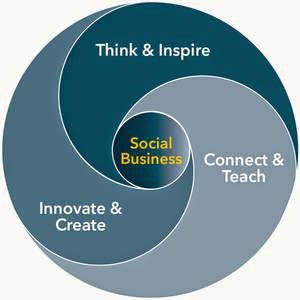
Social business, as defined by SideraWorks is:

"the creation of an organization that is optimized to benefit its entire ecosystem (customers, employees, owners, partners) by embedding collaboration, information sharing, and active engagement into its operations and culture. The result is a more responsive, adaptable, effective and ultimately more successful company."

source
Isn't this what higher ed institutions are good at (or at least aim to be good at) naturally? Our researchers constantly look for inspiring cross-discipline and industry collaborations. Our core mission is effective information sharing with students and the community. Engagement of students, alumni, employers and donors is at the core of student service and advancement offices.

The only stretch is now to do all of these good things in a more strategic way, on a much bigger platform, and for a much wider audience.

But it takes work.
  • It means a heck of a lot of transparent internal communication and installing the right technology platforms to do it with. 
  • It means educating leadership on the benefits of empowering all employees to solve problems, share insights and connect with each other and directly with our customers and partners in order to adapt and evolve.
  • It means involving our customers in forming what the product they are paying for will be.
  • It means a shift in thinking by the marketing team to publish content that is consumer and partner-centred, instead of news celebrating our own achievements and credentials. 
  • It means convincing faculty members that giving their time to speak at public seminars and blog about insights into industry or society will pay off for them in the future with more funding for their work. 
  •  It means listening to what our alumni need to improve their lives and then giving it to them, instead of flooding them with emails to attend events that may not be meaningful to them.
  • And it means directing financial and human resources to take advantage of new social technology and opportunities. 
The result of this effort is surely worthwhile. Adapting our organizations to a social business model will strengthen brand reputation and relationships since value, service, authenticity and transparency will resonate quickly with our audiences. We will become a true community, not an institution.

And the revenue will follow. More importantly, that revenue will be more purposefully directed to the projects and programs that have direct impact on growth - because it will come from partners and customers making informed choices due to engagement with the people who are creating change.

Demonstrating value, connectivity, and collaborative innovation is what will transform an institution into a social business, and thereby drive advancement success.

Note: another good resource on how to build a social business is at Social Business Forum.

why content marketing is key to higher education reputation and revenue

The explosion of content marketing is great news for higher education institutions trying to build reputation and increase revenue streams. For two reasons:

1. We have lots of content. Sure, it may take more effort to encourage and help faculty blog about their research and teaching, but the information they can share is the stuff that starts conversations. We also have students doing incredible things like experiential learning and community volunteering, and we have successful alumni who have wisdom to share about their industry. The effort spent by university marketing and communications folks on building editorial calendars, sparking ideas, and editing articles written by our stakeholders is so much more effective than simply reporting on faculty or alumni success. Articles and blog posts written by the experts themselves are genuine and they elicit discussion, advocacy and action.

2. It's cheaper than traditional marketing. Most universities don't have the budget these days for advertising, so it's beneficial to us that our target audiences pay attention to social media marketing. According to Hub Spot's 2013 Report on Inbound Marketing, inbound marketing-dominated organizations experience a 60% lower cost per lead than outbound marketing dominated organizations. What's more, social media and blogs are proving to generate real business, not simply brand awareness, delivering "54% more leads into the marketing funnel than traditional outbound leads." 

So what do we need to do? 

First, we need to enhance our digital and social presence and find out what channels our target audiences are using.

Second, we need to encourage our faculty, students and alumni to provide us with content about the experience and knowledge they have gained, either directly or indirectly from being associated with our institution. We need to help them understand the payoffs for them -- writing credits and experience, but more importantly, reputational gains that will lead to long-term new revenue invested back into the school, which only boosts their work and credentials even further. 

Finally, we need to direct traditional marketing budgets and human resources into building mobile friendly sites and acquiring data analysis tools and training so that we can become even better at content and inbound marketing. 

Higher-education institutions are ahead of the curve when it comes to content marketing. Let's take advantage of that to build our level of success. 

To inspire your team, take a look at the great infographic on the anatomy of content marketing, from Content Plus


from donor pyramid to advancement pyramid

I'm a big fan of advancement shops over separate marketing, alumni and development shops. And here's why. It's almost impossible for marketing and alumni folks to directly connect their good work on a daily basis to the ultimate goal of revenue if they do not see strategies and tactics and results that move people from conversations and engagement to giving. 

Everyone working in higher education these days knows that universities and colleges are struggling to make ends meet. University leadership is therefore very focused on the bottom line, in order to meet the mission of high-quality research output and knowledge transfer to students and community. 

The best way to boost the university bottom line is by bringing in new revenue. A complete advancement shop whose many resources are all tasked with adding revenue creates a clear and inspiring goal for staff to work toward. 

Does that fly well with marketing shops who are working on building reputation or alumni shops who are building relationships? In my experience, yes. It inspires them to do even better work because they clearly see how reputation and relationship building are critical for new revenue generation and enhancing the university's impact on society. 

Here's how my shop has done it. We've gone from using the traditional donor pyramid to adding a conversation pyramid and an engagement pyramid as well. This "advancement pyramid" reminds us that it takes the whole team working toward the same goal to make a significant impact.


What do think? Do you agree with a shared advancement mission of revenue generation? I'd love to hear from you if have any other models that work well. 

remember to listen...then engage in a meaningful way

Our alumni demographic is changing with each graduating class. Young alumni have different needs than graduates ten or twenty years out. Most of our grads are so busy with career, travel and family that communicating and engaging with them has become a complicated exercise in tactical manoeuvres. But is is really that difficult?

All we really need to do is ask and listen. They tell us all the time what they want. They tell us through open rates on emails, click-throughs on websites, and attendance at events. They tell us through LinkedIn and Twitter connections. And they tell us through boasting publicly about their degree and where it is from. I believe our alumni do want to engage with us, if we do it on their terms.

We need to really hear what they are telling us by analyzing the data we already have, and by going out and personally talking to them, whether in a one-one meeting or at an event they are already at. Face-face connections are invaluable. Listen to the data, find out where they are and go there. Ask them how they want to engage with us, and let them know they have been heard.


In our digital world, it's not hard to customize engagement opportunities based on segmented groups- whether by age, affiliation or industry sector.  Once we understand what a particular group wants and needs, we can give it to them in a content-rich and quick-to-absorb communication piece, through a student interaction, or at an event. We can make it valuable and meaningful for them, and also enjoyable!

They will appreciate being heard, and we will see the return on our investment of time.

lessons from the customer service era

I don't know about you, but my experience as a customer in many stores lately has been truly deplorable. It seems that customer service, and sometimes even simple human decency, is not common sense anymore, let alone part of the training package for employees. When did businesses forget that good service is the key to loyal customers?

It got me thinking, have we gotten lax with donor service as well? With our hectic work schedules and increasingly gigantic goals and responsibilities, are we remembering to be truly donor centered? Sometimes, especially for front-line fundraisers, it can get buried behind the need to do everything possible to secure donations in time for the performance review. Yet we know that just like customer loyalty, donor loyalty is dependent upon great product and service.

So I thought I would review some of the lessons I learned back when I was a student and working part-time in the retail industry:

1. Listen, don't sell. I asked questions to understand my customers' need and gave them the product that fit. Similarly, I need to ask questions to understand my donors' values, desires and passions to be able to suggest an option or project to invest in that will make them feel proud.

2. Put myself in their shoes. By anticipating their needs, I could quickly accommodate customers and give them a pleasant shopping experience. If I understand my donors, I can anticipate the things that will make them feel very comfortable with me and the organization.

3. Be competent. I needed to know my stuff so I didn't recommend a product that turned a customer's hair blue and lose her business. If I don't know my organization and project inside and out and feel passionate about it, I can't expect donors to be moved to action. 

4. Be helpful. I would never have said to a customer looking for something in the store "I don't know." I made it my business to know my store and guide the customer to the aisle they needed. Therefore I must never stare blankly at a donor who asks me about details on their tax receipt or about a planned gift simply because that is not my field of expertise.

5. Be modest. I didn't sell a lipstick by telling a customer that it won the most awards for pigment innovation. I sold it by telling her it would make her look and feel ten years younger.  In the same way, I can't make donors part with their dollars because the school has the highest rankings. Of course product credibility is important, but the donor will only ultimately give because they understand that supporting this project will make them feel great because they are improving the world.

6. Enjoy helping people. I was happiest when the store was incredibly busy and I was helping people and making them smile in the midst of chaos. So why should I feel irritated by an interruption phone call from an alumnus that was put through to me by the reception desk? That may be my chance to make someone's day by answering a question and getting them involved with the school. Hmm...must remember that the next time the phone rings.

7. Say thank you. I may have thrown a free gift in the customer's bag, but if I didn't say thank you, she still would not have had a great experience. Simply saying thank you in a direct, timely and meaningful way is all a donor needs, and it goes such a long way.

Happy donors = loyal donors. Right? Now if only I could buy a pair of shoes without getting attitude. 

social media: the best thing to happen to university advancement since the invention of homecoming

That's right. While companies are struggling to adapt to social media marketing, university advancement teams are (or should be) rejoicing that we now have tools to enhance what we've always done best: build real relationships and make connections.

source
Bill Lee, in this HBR article, rightly states: "traditional marketing is dead." However, peer-based, community-oriented marketing is now thriving because of social media. Lee reminds us to focus on two important things: 1. find influencers; and 2. give them social capital.

The influencers we've traditionally identified will likely be different than social media influencers. And that's a good thing, as we certainly need to focus on building more and better relationships with our stakeholders that don't have gray hair. We can give them social capital by empowering them with information and knowledge that will help them with their careers, their bosses, their employees, their businesses, their peers and their resumes. And then they can share this info and help others as well. We can provide them with value that will make them not only want to promote us, but also solidify a lifelong connection.

Mark Bonchek backs this up by stating that social media is a gift economy, unlike our traditional market economy. In a gift economy organizations must create social currencies related to our brand, and also earn status, not buy it. If we enable our constituents to connect with each other and with us in this way, we will build deep engagement with them that goes far beyond what traditional marketing could ever do.

Advancement teams at universities have long known that sustained growth is built through authentic customer relationships. We must therefore take advantage of every social media tool that makes sense in cultivating those alumni/student/donor relationships we've already begun. And we can reach so many more with social media marketing.

We're already ahead of the game. Let's keep the momentum going.

fuel engagement in your organization

I've been hearing a lot about how the London2012 Olympics have been such a success due to the throngs of engaged volunteers. A recent post on the Harvard Business Review explored how enthusiasm from the volunteers spilled over to all kinds of other workers around the city and resulted in productivity above the normal expectations of a typical unengaged workforce. The argument is that if organizations do more every day to draw on and fuel enthusiasms, and less to maximize efficiency, the problem of disengagement would be gone forever.

We talk a lot about engagement in university advancement, but we usually focus it on alumni and donors. We inherently understand that for our stakeholders to be engaged, we must fuel their enthusiasm and earn their trust. But do we behave the same way with our staff and colleagues?

Unfortunately, high turnover exists in the advancement industry and can hurt relationships that are building between the institution and a stakeholder. Hopefully, the engagement officer has done a good job in creating a broad relationship between the stakeholder and the school in the area in which they hold interest so that their departure has minimal effect. Then again, good work is done by engaged employees, and disengagement is the number one reason why employees leave.

Why don't we use the same approach with our staff and colleagues as we do with our stakeholders? We know it works. We know that if we build mutually profitable long-term relationships, they will lead to satisfaction, trust and results. In fact, Tony Schwartz and his firm The Energy Project are proving it. He works with companies to "shift their paradigm from getting more out of people by pushing them harder, to investing more systematically in meeting their needs, so they're freed, fueled, and inspired to bring more of themselves to work every day."  In an interesting HBR article he reasons that workers (and possibly women in particular) are so busy in today's fast-paced world that if they are given the flexibility to do their work when and how they need to, they will have the focus and energy to do a better quality job.

The advancement world is filled with a high percentage of women doing high-energy jobs like development and alumni front-line work. Schwartz's theory makes a lot of sense in this space. After all, we want to build quality, fulfilling relationships with our stakeholders, and constantly fuel them, inspire them and meet their needs so that they will give back. We naturally then need equally engaged, loyal and passionate front-line people to make those connections and achieve that goal for us.

Taking the time to fully engage and trust our staff will deliver extraordinary value to the institution that is measurable and sustainable. In the end, that's what we all want.

focusing on the right hero

Ever watch those interviews with Olympic athletes who give you a glimpse into who they really are? They remind us of what a hero really is. It's the person behind the headlines, the one who has shown us that their drive, determination and hard work has allowed them to expend their talents. It's the person who inspires others to be the best they can be.

So who should we be celebrating as the heroes of our own institutions? If you're thinking students and researchers, you've got it backwards. It's our supporters.

Too often we take our story out to the community and market our product- that being our students and our faculty. All well and good, but to inspire someone to support us, we need to tell their story, not ours. They are the hero - someone who makes a real difference. They are the ones who are doing life-changing work by enabling and inspiring us. Therefore, our message should be: we make the work of our supporters possible, not vice-versa.

Let's make our supporters central to our story as the heroes in the change we are seeking to make.

advancing university advancement: breaking down silos

We can't deny it any longer: times have changed. Gone are the days when homecoming events were all it took for alumni engagement. Gone are traditional campaigns that ramped up and wrapped up in five years. Gone are the budgets to build staff in advancement offices. So what can we do to get ahead of this transition?

Use what we already have.

The largest and most valuable resources on a university campus are the students and the faculty. We have energy and expertise in these two groups that we can and should use to build stronger relationships with our stakeholders - without hiring more staff. But university departments often work in silos, and that tradition is tough to break. The advancement team should work across campus to help tear down the walls and build relationships within the institution in order to grow relationships outside of it.

Let's start with faculty. Every school holds an enormous amount of knowledge and interesting work being produced through faculty members and researchers. If advancement professionals build relationships with these individuals and educate them on the benefits of engaging alumni and friends, faculty will become our best advocates. Encourage them to come out to events and talk about their work. Bring the media to them as subject matter experts. Bring alumni to campus to meet with them in their labs and classrooms. They will be be grateful for the interest in their work and alumni and community members will know the cool things happening on campus.

OK, now for our students. Some schools do a good job of getting students involved with advancing the institution, but often we are so focused on engaging alumni that we forget to include our students, who are also part of that distinguished group. At every alumni, donor and community event make sure to seat students at tables with alumni and professionals in order to build networks. Work closely with Career Centre offices in order to build innovative programs that benefit both students and alumni mentors. Work with student clubs to help them with events and finding guest speakers - a great engagement opportunity.

Let's face it: our stakeholders are sophisticated, busy and expect more from us if they are to become involved. Engagement needs to be the focus across all parts of campus, not just the Advancement Office. When all participants understand the impact that this will have, we'll be able to get them on board.

But...

if we want to break down silos across campus, we need to start with our own shop. Integration is key to achieving our goals.

The Alumni and Outreach group needs to step up and play the lead role in building and maintaining meaningful networks. This will mean getting alumni and volunteers involved in ways that they tell us will be meaningful to them, not the other way around. It will most likely involve working closely with career services offices and also with executive education programs. Alumni officers should be front and centre as the go-to  for alumni, students and faculty who want to help advance their institution and create reciprocal relationships.

The Communications group needs to back these efforts up with consistent and disciplined messaging and help with social media technology and strategies. Marketing should create an environment of listening to stakeholder needs, and responding to them and giving them content that will add value to their lives' And marketing should also should be constantly and strategically sharing all of the good things that our faculty and students are doing. The community wants to know who we are and what impact we make on society.

All of this should pave the way for the Development group to then visit with engaged alumni and friends who are ready to give to the area within the school that they feel will help make a significant impact in the school and in the world. If Alumni Officers have done their jobs, Development Officers will need to spend less time on building a relationship and more time on listening to what an individual is passionate about and therefore include them in a project with a faculty member or student early on, so that there can be joint ownership.

Notice I say alumni and friends, not donors. I think that is one more silo that we must break down: all of our donors remain alumni and friends, whether they are giving in a particular year or not. Labeling them donors infers that we are conditionally interested in them. We are not. Alumni, through their years of giving time, talent, treasure or advocacy will always be valuable to the institution, and we must always treat them as such.

So, what are you doing to break down your silos?

face-face and social media fundraising: one and the same

The new world of fundraising looks like this: content marketing, SEO, digital advancement managers, twitter campaigns, and crowdfunding. Yes, things have changed, but the fundamentals are still the same. It's all about building relationships and engaging your stakeholders.

The same old rules of face-face fundraising still hold true. What are they again?

1. Have a strong Case for Support. Your fundraising efforts will only be as strong as the case for what you want your donors to support. This has to come first. Your organization and the project has to be strong, and your online messaging has to be equally as strong in conveying that. Content  is king. If you don't have something important and valuable to post on your web and social media pages, don't say anything. Your aim, just as in "real life" is to have great conversations that will engage stakeholders and build the foundation for a strong relationship.

2. Get out there. A good fundraiser is one that is constantly meeting with people, making connections, and engaging in conversation with donors and prospects. A good fundraising organization is one that does the same thing online. Digital marketing is not the same as traditional marketing. It's about having two-way conversations and engaging people, not simply throwing information or calls-to-action at them. Organizations should find where their target audiences are on social media and be chatting with them and giving them shareable content often and regularly.

3. Listen. Just like with in-person meetings, 90% of the talking should come from your audience. Organizations need to listen for what their online stakeholders are passionate about, what drives them, and what does not. They will be your greatest source of information.

4. Engage influencers. Our greatest assets on the street are our influencers. Donors who are engaged with our organization will influence friends and peers to join the cause. Engaged online followers of an organization can be an army of influencers with an audience bigger than we've dared to dream of. Engage them, empower them to talk about you, and make it easy for them to share information. Set up groups and have share buttons and links on all of your sites that are easy for an influencer to spread around.

Yes, the non-profit world may look a bit different these days, but we all know what we are doing because they are the same things we've been doing for years: building engaged relationships and trust. Happy tweeting!

engaging donors through social media

You know how important social media is. You know your constituents - both young and old - are using it. Are you?   

Non-profits wanting to propel their mission forward and not be caught in the status quo must build an active and integrated social media strategy to engage their stakeholders. Building and keeping an engaged constituency is only becoming tougher as people become busier with many areas of their lives.  Twitter, Facebook, Google +, YouTube, LinkedIn and other social media sites are an easy way to keep them involved and let them be “active” in talking about, and therefore promoting, your organization.

Take Mike for example. He is a university grad who is 15 years out from graduation, has a rapidly rising career that demands a lot of his time, and is starting a family. He had a great experience at his alma mater and would like to stay involved more than he does, which currently consists of modest sporadic donations. Although the university has asked him, he doesn’t have time to mentor a student, guest-lecture in a class, or attend alumni events. What could he do to help the university and feel connected? 

He could help spread the word to his peers about news and events at the school through social media networks. He is on Twitter and LinkedIn.  Many of his contacts include business peers who are former classmates.  The university could engage him online through good content and discussion, and he would then share important messages and forwarding invitations to events and appeals for donations.  The school should have a LinkedIn group where they (and he) can brag about the support he gives and the project he gives to at the school. This will not only make him feel as if he is doing his part, but also keep him more connected so that he will be more and more willing to increase donations. Oh, one thing- it must be easy for him to share information and donate online.

The old adage that the best marketing is word-of-mouth holds true in today’s plugged-in world. Remember that you want to talk with them, not to them. Have content worth spreading. Make it personal by engaging in inspiring conversations, not just one-way announcements. Make sure to follow what is being said about you online. This way, you can join in the conversation and add value, thank your constituents and even correct misconceptions. It’s also a great way to learn what is relevant to them. And as we already know, this is the key to build lasting donor relationships, online or off.